
Best cat tree for a small apartment
By the MCC team · 7 min read · Reviewed for accuracy
The best cat tree for a small apartment is tall and narrow: it uses vertical space instead of floor space, stands on a heavy or anchored base, and puts at least one perch above your eye level.
No yard, no spare room, a landlord who counts the square footage — and a cat who still expects a kingdom. Good news: the best cat trees for small apartments don’t ask for floor space. They ask for vertical space, which even the tiniest studio has plenty of. Here’s how to pick one that fits your apartment and satisfies your cat.
Why your cat wants height in the first place
Cats are climbers by instinct. Height means safety (a clear view of the room), territory (the high spot is theirs), and entertainment. In a small space where a cat can’t roam far horizontally, going vertical is how you give them a bigger world without a bigger apartment. A tall tree in a corner often does more for a bored indoor cat than a floor full of toys.
Go tall and narrow, not wide
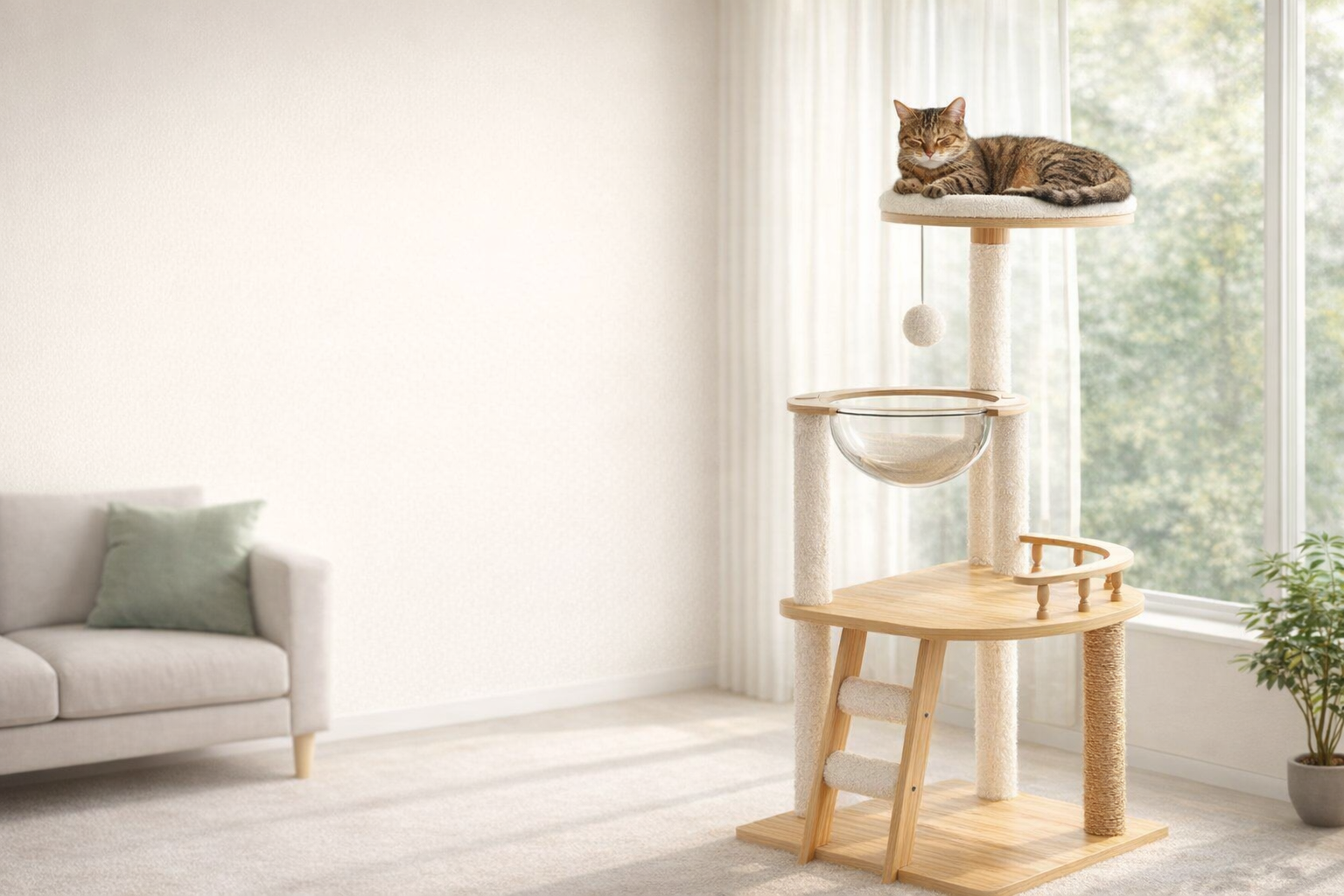
The single most important rule for small spaces: prioritize footprint, not height. A 5-foot tree with a 16-inch base beats a sprawling 3-foot tower that eats half your living room. Look for towers with a small, weighted base and levels stacked upward rather than out. Corner placement makes a tall tree feel built-in instead of in-the-way.
Make sure it’s actually stable
Tall and narrow only works if it doesn’t wobble — a tippy tree is a tree your cat will never trust or use. Look for a wide enough base, thick center posts, and ideally a strap to anchor the top to the wall (worth it for taller models and a must in earthquake country). Heavier is usually better; a tree that feels flimsy in the box will feel flimsy under a launching cat.
Match the features to your cat
- Big jumpers and younger cats: more levels and a tall perch up top.
- Senior cats or kittens: closely spaced platforms or a built-in ramp so they’re not making big leaps.
- Shy cats: a tree with an enclosed condo or cube to hide in.
- Scratchers: sisal-wrapped posts pull double duty as a scratching surface (and may save your couch — more on that in our guide to cat scratching).
Bonus: use the window
In a small apartment, a tree placed by a window turns one corner into your cat’s favorite room in the house — sunbathing, bird-watching, and napping all in one. If a full tree won’t fit, a sturdy window perch is the small-space shortcut.
Three layouts that work in a studio (with real measurements)
Most “small apartment cat tree” advice stops at “buy a tall one”. Here are the three layouts we see actually working, with the footprint you give up for each.
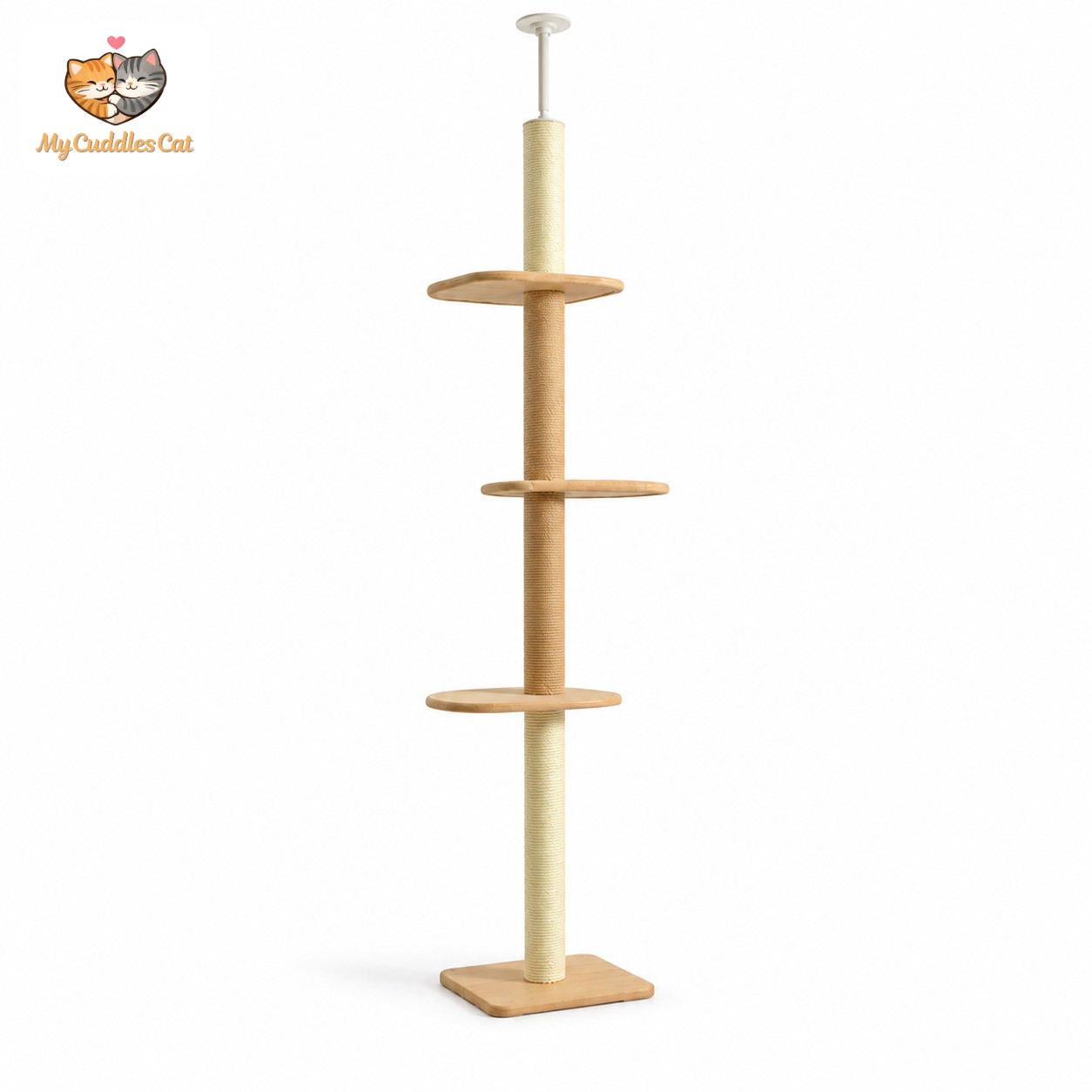
- The corner column (about 2 × 2 ft of floor). A floor-to-ceiling tree held by a tension rod uses the one place nothing else fits: the corner. Our Summit Cat Tower adjusts from 89.75 to 102.25 in to lock against an 8 ft ceiling, so the whole climb is vertical and the base tucks behind a sofa arm. Best for one or two cats who like to go up, and for renters, because nothing is screwed into the wall.
- The side-table tower (about 16 × 16 in). A mid-height wood tower stands where an end table would. The 41 in Modern Cat Tower is 15.7 × 15.7 in at the base, 11.3 lb, with sisal posts and an acrylic hammock — it reads as furniture, so it can sit beside the couch instead of being hidden. The 49 in version adds an enclosed condo for a cat who likes a den.
- The wall route (zero floor). When even a corner is spoken for, wall-mounted cat shelves put the climb on the wall: a hammock, three-step sisal stairs, a platform and a two-step tree, each rated to 22 lb. You need a drill and studs or masonry anchors, so this is the owner’s option more than the renter’s.
How to measure before you buy
- Ceiling height. Tension-rod trees need a solid ceiling (not a drop ceiling) and a listed range that includes yours; standard U.S. ceilings are 8 ft, so a 7.5–8.5 ft range is the one to look for.
- Base footprint vs. the spot. Tape the base dimensions on the floor where the tree will go. If the tape overlaps a door swing or the path to the litter box, pick a narrower tree.
- Jump distance between levels. Cats clear 12–18 in comfortably; seniors prefer under 12 in. A tree with stairs (both Modern Cat Tower sizes have them) is the kinder choice for an older cat.
- Weight of the tree vs. weight of the cat. A free-standing tree under 10 lb will rock under a 12 lb cat. Either go heavier (the 49 in tower is 18 lb) or go tension-rod, which cannot tip.
Big cat, small apartment
Searching for a cat tree for large cats usually turns up sprawling carpeted towers that need a wall of their own. In a small place, the trick is rigidity rather than width: a tree that is locked to the ceiling stays still when a 15-pound cat launches to the top, which is exactly where a wide-but-light tree fails. For a Maine Coon mix in a studio, the Summit (ceiling-locked, sisal posts, four rounded platforms) is the one we recommend first; if you prefer free-standing, choose the 49 in Modern Cat Tower for its 15.5 × 18.7 in base, three posts and enclosed condo.
Renting? Floor-to-ceiling vs. free-standing
A tension-pole tree looks like it should be off-limits in a rental, but it leaves no marks: the top cap presses against the ceiling with a rubber pad and the base sits on the floor. Nothing is screwed or glued, and it comes down in two minutes at move-out. Wall shelves are the opposite — they need stud screws and patching later. So the rental order of preference is: tension pole first, then a free-standing wood tower strapped with a removable anti-tip kit, and wall shelves only with the landlord’s nod. Our Summit Cat Tower fits ceilings from 89.75 to 102.25 in; measure yours before ordering.
Noise, neighbours and the 3 a.m. zoomies
In an apartment the tree is also a sound source. Carpeted condos muffle landings; wood platforms amplify them. If you have downstairs neighbours, put a thick rug under the tree, keep the top perch over a soft landing (the sofa, a bed), and give your cat a ten-minute play session with a wand toy before bed so the midnight sprint happens before you sleep rather than after. A floor-to-ceiling pole transmits less impact to the floor than a wide tree because the cat climbs rather than leaps between levels.
Keeping it looking good in a small space
In a studio the tree is part of the décor whether you like it or not. Three tricks: choose a tree whose colour matches your largest piece of furniture rather than the walls; keep the top perch clear of toys and blankets so it reads as furniture; and put a plant or lamp beside it so it belongs to a “zone”. Wood-and-sisal towers like the Modern Cat Tower blend in far better than beige carpet condos, and they wipe clean instead of holding fur. For the layouts and spacing of a wall-mounted alternative, see our cat wall shelves guide.
If your “small apartment” cat is a big cat
Everything above assumes a 8–12 lb cat. Over that, stability becomes the deciding factor — the base-to-height rule, per-platform weight ratings and a 16-inch top perch. We cover those numbers in Best cat tree for large cats; the short version is that the tension-pole tree is still the right answer, because the ceiling brace does what a wide base cannot in a small room.
The five-minute measuring checklist
- Floor-to-ceiling height at the exact spot (for a tension pole) — check for ceiling fans, cornices and sloped sections.
- Floor footprint you can give up, in inches, not “a corner”.
- Your cat’s weight and nose-to-rump length (top perch should be 70% of the length).
- Window-sill depth and height if a perch is part of the plan.
- Door swing and walkway clearance — the tree must not block a path you use at night.
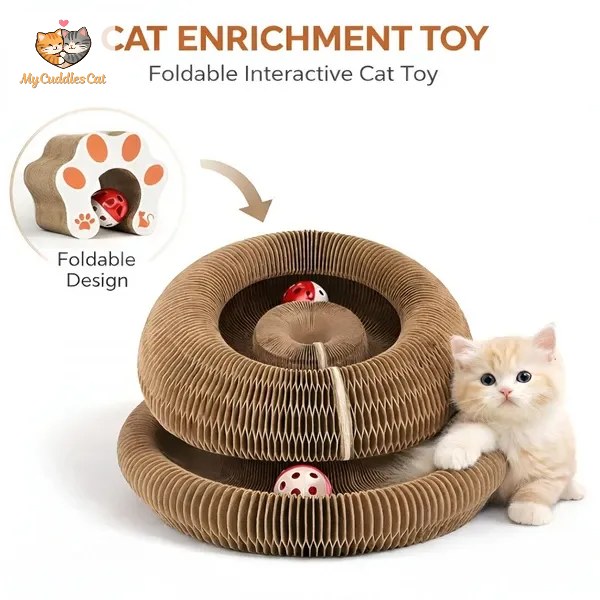
Short on floor space? An accordion cat scratcher or a sisal cat scratcher bed adds a scratching surface at floor level without the footprint of a second tower.
Frequently asked questions
Do I need a cat tree with carpet?
No — a cat tree without carpet (wood platforms, sisal posts) sheds less fur, wipes clean and looks like furniture.
Should I get a tension-rod or a free-standing cat tree?
Tension rod if you rent or have a big cat; free-standing if your ceiling is sloped or a drop ceiling.
How tall is tall enough for a cat tree?
Anything with a perch above your eye level counts as “high ground” to a cat; 41 in on top of a sofa-height sightline already does it.
Our pick
For tight spaces, our Summit Cat Tower is built tall-and-narrow with a weighted base and a wall-anchor strap — kingdom-sized fun on a small footprint. Browse the rest in Towers & Scratchers, all shipped from the U.S. in 5–8 business days.
Not sure it’ll fit your corner? Send us your dimensions — we’ll help you pick.