-
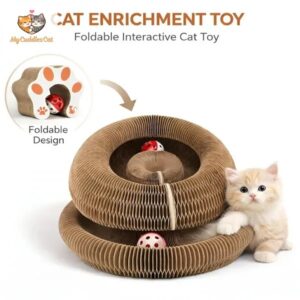
$32.95A cardboard scratcher that stretches, bends and snaps into a ring — with a rolling ball inside to chase between scratches.
- Accordion-fold corrugated cardboard: pull it open, bend it into shape
- Magnetic ends connect to form a ring
- Rolling ball stays inside the track
- Scratching surface all the way around
- Opens to about 9.6 in across and 4.4 in tall; folds flat
-
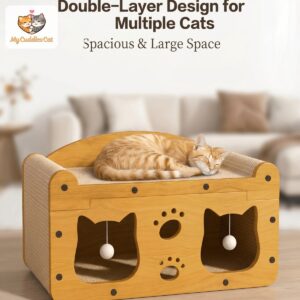
$56.95A two-level cardboard cat house: a scratcher sofa bed on top, a private cave below, and hanging balls in the doorways.
- Top level: corrugated scratcher bed with a curved backrest
- Lower level: enclosed cave with cat-face doorways
- Hanging ball toys in the openings
- The two layers separate, so you can use them stacked or side by side
- 22 x 11.8 x 11.8 in, wood-grain print finish
-
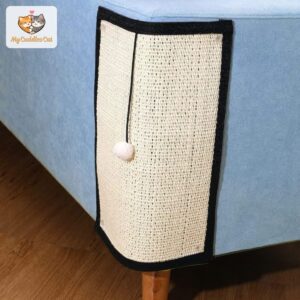
$37.95A woven sisal scratch mat that pins over the sofa corner your cat already scratches, so the claws land on sisal and not on your upholstery.
- 11.4 x 15.7 in (29 x 40 cm) natural sisal mat with a black fabric border
- 10 twist pins included for fixing it to fabric upholstery
- Also works flat on the floor as a horizontal scratch mat
- Ball toy on a string to draw your cat to the mat
- Light and flexible: about 3.5 oz (100 g)
-
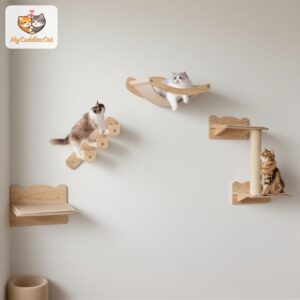
$129.95Four wall-mounted pieces — hammock, sisal stairs, platform and 2-step tree — that give your cat a climbing wall with zero floor space.
- Rated to 22 lb per piece
- Sisal-wrapped stairs double as a scratcher
- Faux-linen hammock for high naps
- Plywood boards in natural wood
- Expansion screws included (drill needed)
-
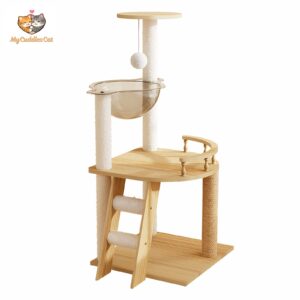
$109.95 – $134.95Price range: $109.95 through $134.95A light-wood modern cat tree with sisal posts, a clear acrylic hammock and a padded top perch — in 41 in or 49 in with condo.
- Natural sisal rope posts for full-stretch scratching
- Clear acrylic hammock cats curl into
- Padded top perch at 41 or 49 inches
- 49 in adds an enclosed condo and side platform
- MDF wood + white finish that fits a modern room
Best for: modern homes with one or two cats that want a scratch, a climb and a high nap spot. Not for: cats that need a tower taller than 4 ft — see the Summit Cat Tower.
-
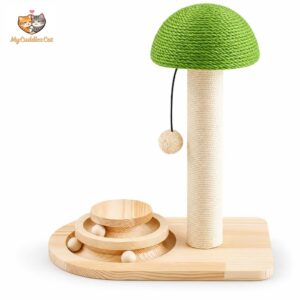
$64.95A sisal scratching post and a ball-track toy in one, on a footprint smaller than a doormat.
- Natural sisal rope post with a mushroom cap — the texture cats choose over your couch
- Two-level wooden ball track built into the base for solo play
- Dangling sisal ball for bat-and-chase games
- Solid wood base, 15.7 in long, stays put mid-scratch
- 20 in tall — sized for kittens and small to medium cats
-
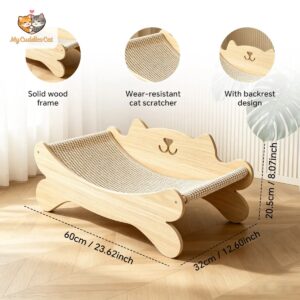
$46.95A scratcher your cat can sleep on: a curved sisal lounge on a solid wood frame, with a cat-ear backrest to lean into.
- Scratcher and bed in one — saves floor space
- Wide curved sisal surface for full-stretch scratching
- Solid wood frame that stays put
- Raised backrest supports the head and neck
- 23.6 x 12.6 x 8.1 in
-
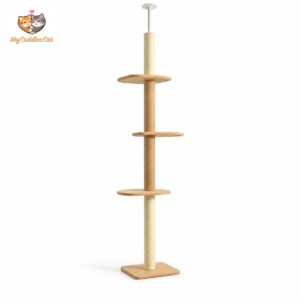
$129.95Kingdom-sized height on an apartment-sized footprint. The Summit is a floor-to-ceiling cat tree (up to 8.5 ft) with three round plush platforms plus a wide base — four levels in all and sisal-wrapped scratching posts — held rock-steady by a tension rod against your ceiling, so it never wobbles. Ships from our U.S. warehouse.
Best for: apartments, small rooms and multi-cat homes that need height without giving up floor space. Not for: rooms with ceilings higher than 8.5 ft.
-
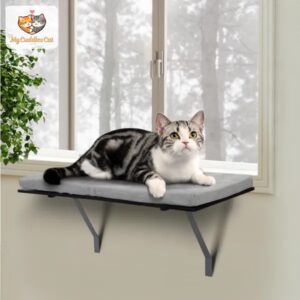
$64.95A 24 × 12 in sill-mounted cat window perch with a washable velvet cushion — no suction cups, no drilling, rated to 22 lb.
- Rests on the sill, braces against the wall with two steel legs
- Works on sills as shallow as 1.7 in
- Removable, machine-washable velvet cushion
- Holds cats up to 22 lb
- Folds flat; 15-minute assembly
Vertical territory: why every indoor cat needs height
Climbing isn't a hobby for cats — it's how they claim territory and feel safe. A tall perch gives an indoor cat a bigger world without a bigger home, which is why a good tree in a corner often does more for a bored cat than a floor full of toys. In a small space, the rule is footprint over height: a tall, narrow tower like our Summit Cat Tower beats a sprawling short tree that eats the living room. Wall-mounted cat shelves take that idea further — climbing space with zero floor footprint. Our full small-space playbook: best cat tree for a small apartment.
Stability decides everything
A tippy tree is a tree your cat will use exactly once. Look for a weighted base, thick center posts, and use a wall anchor on anything tall. A tree that feels flimsy in the box will feel flimsy under a launching cat.
Scratching is a need, not a habit
Cats scratch to shed claw husks, mark territory, and stretch their whole body — you can't stop it, only redirect it. A post should be tall enough for a full upright stretch and rock-solid; flat pads cover the cats who prefer to scratch horizontally. That's why our Mushroom Scratch Post is a full-height sisal post, and why the sisal-wrapped stairs on the Cat Wall Furniture Set double as a scratcher on the way up. If the couch is currently losing, our step-by-step fix: how to stop a cat from scratching the furniture.
Match the layout to the cat
Big jumpers want widely spaced platforms and a tall top perch. Kittens and seniors need closely spaced levels or a ramp. Shy cats appreciate an enclosed condo mid-tree. And any tree by a window doubles as entertainment — sunbathing, bird-watching, and napping in one corner. Pair it with a cozy landing zone from Beds & Caves.
Cat trees for large cats, modern cat towers and wall shelves
Three ways to add height, by the cat and the room. A cat tree for large cats needs a wide, heavy base and big platforms — the 49 in Modern Cat Tower (18 lb, enclosed condo) and the ceiling-locked Summit Cat Tower are the two we rate for Maine Coon mixes (more in the best cat tree for large cats). A modern cat tower in natural wood with sisal posts replaces carpeted towers for anyone who wants cat furniture without carpet. And when there is no floor space at all, cat wall shelves — the four-piece Cat Wall Furniture Set with hammock and sisal stairs — build a climbing wall at zero footprint, while a sill-mounted cat window perch gives the lookout cats want most. Layout ideas are in cat wall shelves ideas.
Cat tree, cat tower or cat condo: what is the difference?
The names overlap. A cat tree is any free-standing frame with platforms at several heights. A cat tower usually means a taller, narrower tree built for climbing, and a cat condo is a tree or box with an enclosed cubby for hiding. Shops use all three for the same piece of cat furniture, so compare the measurements rather than the name: base width, total height, platform size and weight rating. Ours are the Modern Cat Tower (41 in or 49 in) and the floor-to-ceiling Summit Cat Tower.
How tall should a cat scratching post be?
Tall enough for a full-body stretch: at least as tall as your cat standing on their hind legs — for most adult cats that means about 28 inches or more. Short posts get ignored because they don't allow the stretch cats scratch for.
Where should I put a cat tree?
Near a window if possible, in a room the family actually uses. Cats want height where the action is — a tree hidden in a spare room rarely gets used. Corner placement makes tall trees feel built-in instead of in-the-way.
Sisal or cardboard — which scratcher is better?
Most cats prefer sisal rope or fabric for vertical scratching and cardboard for horizontal. If you don't know your cat's preference yet, offer one of each and see which takes the damage — that's your answer.
How do I stop a cat tree from wobbling?
Put it on a hard floor or low-pile carpet, re-tighten every bolt after the first week of use, and anchor it to the wall if it is tall. If it still wobbles, the base is too light for your cat.
What is the best cat tree for large cats?
Look for a base at least 15 in on each side, platforms wide enough for the cat to lie flat, and a frame over 15 lb — or a tower that locks to the ceiling. Our 49 in Modern Cat Tower and the Summit Cat Tower both meet that bar; a light 10 lb tower will tip under a big cat.
Are cat wall shelves safe for heavy cats?
Yes when each shelf is rated for the weight and mounted into studs or masonry. Our wall set is rated to 22 lb per piece. Hollow-drywall anchors alone are the usual point of failure, so find a stud or use the included expansion anchors in brick or concrete.
Towers & Scratchers guides