
Cat Wall Shelves Ideas: How to Plan, Space and Mount a Cat Wall Safely
By the MCC team · 9 min read · Updated November 2026
Cat wall shelves are the only piece of cat furniture that gives your cat more territory while giving you floor space back. Done well, a cat wall looks like intentional décor and gets used every single day; done badly, it is a row of shelves your cat ignores or, worse, one that pulls out of the drywall. This guide collects the cat wall shelves ideas that actually get climbed, the spacing numbers behind them, and a step-by-step on mounting shelves safely — including what to do if you rent.
Why cats use some walls and ignore others
Cats climb for three reasons: to survey the room from above, to escape (other pets, children, a vacuum cleaner), and to travel without crossing the floor. A cat wall gets used when it serves at least two of those. That means every layout needs a destination — a wide perch, a hammock or a window view at the top — and a route of steps a cat can take without an all-out leap. A single shelf stuck at random height serves neither purpose, which is why so many first attempts gather dust.
The spacing rules (measure before you drill)
- Vertical gap between steps: 12–16 in for adult cats, 10–12 in for kittens, seniors or cats over 15 lb. A healthy adult can jump far higher, but comfortable daily use happens at step height, not jump height.
- Horizontal offset: 8–14 in between the edge of one shelf and the start of the next, so the cat moves diagonally up the wall rather than straight up.
- Perch depth: at least 9 in for a step, 12–14 in for a lounging shelf, 16 in+ for a large cat’s top perch.
- Clearance above the top shelf: 18 in minimum to the ceiling so the cat can sit upright.
- Distance from the floor to the first step: 16–20 in — or start from a piece of furniture the cat already uses.
Six cat wall shelves ideas that work in real homes
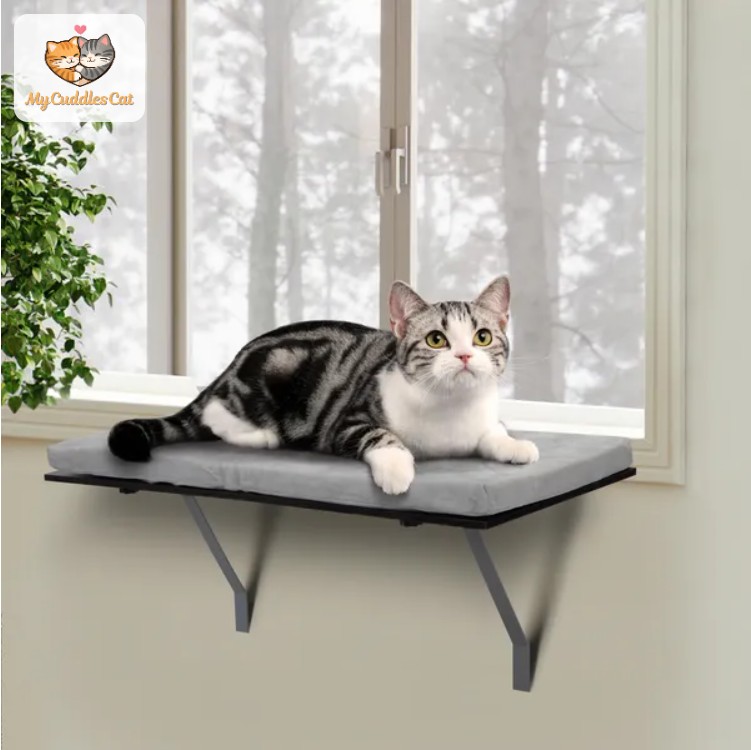
1. The staircase to a window
Three or four shelves rising diagonally to a window perch. The window is the destination, so this layout gets used even by lazy cats. Pair the shelves with a sill-mounted perch at the top and you have a complete route without a single floor-standing piece.
2. The lounge wall (sisal stairs + hammock)
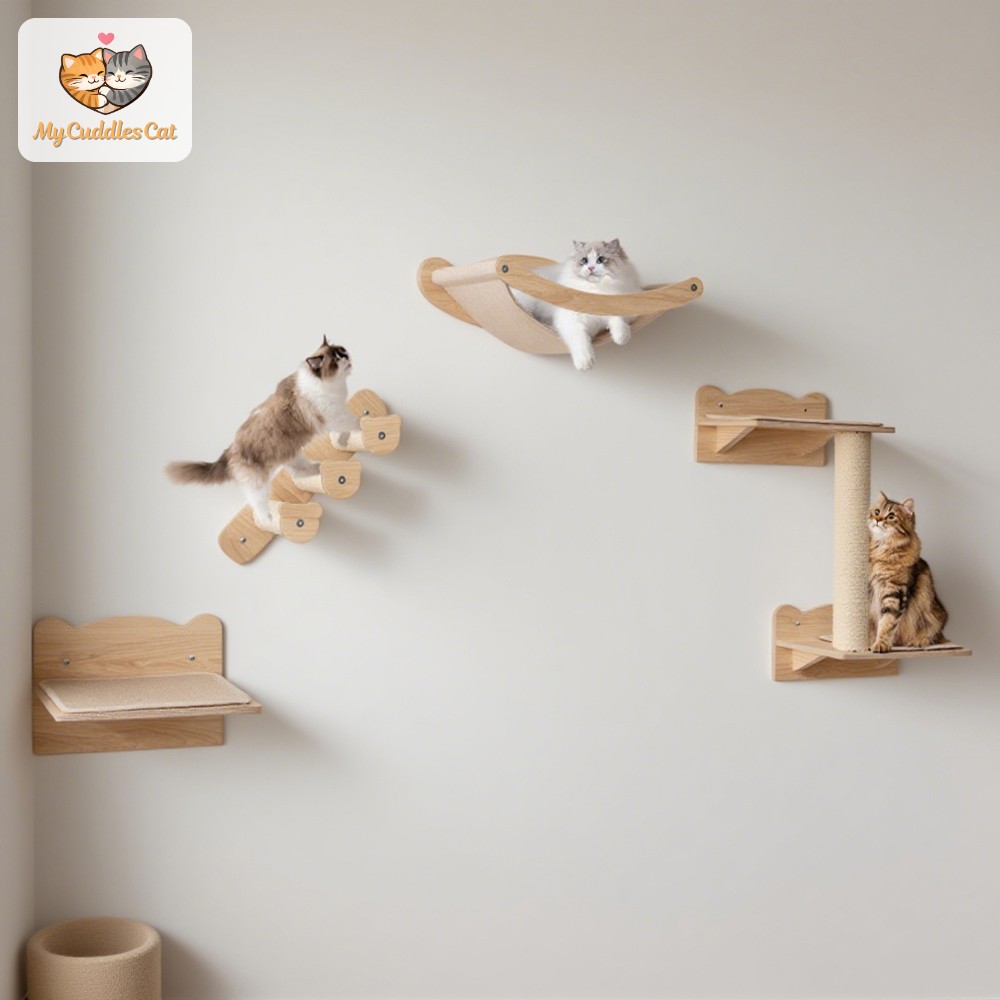
Two sisal-wrapped steps leading to a hammock and a flat perch at the same height. The steps double as scratchers, which protects the sofa below. This is the layout our Cat Wall Furniture Set is designed around: four pieces, each rated for 22 lb, that cover a 6-foot-wide wall section.
3. The highway over a doorway
A long shelf above a door connects two walls and turns the room’s perimeter into a loop. Cats love it because they can cross the room without touching the floor; owners love it because it uses space nothing else can. It needs a sturdy 36-inch-plus shelf fixed into the header above the door.
4. The corner tower
Shelves alternating between two adjacent walls in a corner. The cat zig-zags upward in a tight footprint, and a corner gives two walls’ worth of stud positions to choose from. Ideal for small bedrooms.
5. Tree-plus-shelves hybrid
A floor-to-ceiling pole such as the Summit Cat Tower provides the vertical climb; two shelves beside it provide the lounging. This is the fastest way to build a cat wall when you only want to drill two holes, and it suits multi-cat homes because the pole and shelves give each cat its own spot.
6. The renter-friendly wall
If you cannot drill, build the “wall” out of free-standing pieces placed against it: a tall tree at one end, a bookcase with a cleared top shelf, and a sill perch at the window. You get the same route-plus-destination logic with zero holes, and it moves with you. Skip adhesive strips for anything a cat will land on — they are rated for static pictures, not a 12-lb cat jumping.
How to mount cat wall shelves safely (step by step)
- Find the studs. Use a stud finder, then confirm with a thin nail; U.S. studs sit 16 in apart (sometimes 24 in). Mark the centre of each.
- Plan on paper first. Cut paper templates the size of each shelf and tape them up using the spacing rules above. Live with them for a day; adjust before you drill.
- Fix into studs wherever a cat will land. Use 2.5–3 in wood screws into the stud centre. Shelves that only hold a sleeping cat can use heavy-duty toggle or snap-toggle anchors rated 50 lb+ in drywall; avoid plastic expansion plugs for anything a cat jumps onto.
- Level every bracket before the final tightening; a 2-degree tilt is enough for a cat to slide off a smooth shelf.
- Load-test with your own hand. Push down hard and sideways on each shelf. Any flex means the fixing is wrong — fix it now, not after a fall.
- Add grip. Bare wood is slippery. Sisal, carpet tile or a non-slip mat on each landing shelf prevents overshoots.
- Re-torque after two weeks. Screws settle in wood; a quick check keeps everything rigid.
Are cat wall shelves safe?
Yes — when they are fixed into studs or proper anchors, spaced so the cat steps rather than leaps, and the top perch has enough depth for the cat to turn around. The failures we hear about trace back to three things: drywall anchors on landing shelves, shelves spaced too far apart (the cat jumps and misjudges), and slick surfaces with no grip. For seniors and kittens keep gaps at 10–12 in and add a soft landing (a bed or rug) below the wall. Never position the top perch above a hard-edged piece of furniture.
Cat wall shelves for large cats
Over 15 lb, prioritise depth and per-shelf rating over quantity. Look for 12 in+ landing shelves, a top perch of 16 in or more, and a stated load of at least 20 lb per piece (ours are 22 lb). Reduce vertical gaps to 12 in; heavy cats prefer to step. If you have a Maine Coon-sized cat, read our guide to the best cat trees for large cats first — the structural rules there apply to walls too.
Getting your cat to actually use the wall
Most cats need an invitation. Put a treat on each step the first few days and let them discover the route at their pace; carrying a cat onto a high shelf usually backfires. Place the wall where the cat already spends time — the living room, not the spare room — and make the top perch the most comfortable spot in the house with a folded fleece. If one shelf is skipped repeatedly, it is almost always a spacing problem: move it 2–3 in closer to its neighbours.
Cat wall shelves vs. a cat tree: which should you buy first?
If you own your home and have a free wall, shelves first: they cost less per foot of climbing, take no floor space and never tip. If you rent, move often, or your walls are plaster, brick or hollow partitions where studs are unreliable, a floor-to-ceiling pole gives you the same vertical route with no permanent damage. Most multi-cat homes end up with both — the tree is the route, the shelves are the beds — because two cats will not share one top perch for long. Budget-wise, a four-piece shelf set plus screws runs about the price of a mid-range tree, and installation takes one person roughly 90 minutes including the paper-template step. Buy the shelves before the tree if your cat already climbs the bookcase; buy the tree first if your cat mostly scratches and sleeps on the floor and needs encouragement to go vertical.
Where on the wall: placement that cats choose
The best wall is the one facing the room’s main activity — the sofa wall in a living room, the wall beside your desk in an office — because cats climb to be near you while staying out of reach. Walls with a window at one end are the strongest choice of all. Avoid walls above radiators (too hot in winter for a lounging shelf), behind doors that swing, and in hallways with no stopping point. Keep the top perch at least a foot away from ceiling lights and anything fragile on a nearby shelf; a cat that overshoots a landing will knock it down.
Not every cat wants to climb. For floor-level cats, a sisal cat scratcher bed or a felt cat house gives them a spot of their own below the shelves.
Frequently asked questions
How far apart should cat wall shelves be?
12–16 inches vertically and 8–14 inches horizontally for a healthy adult cat; 10–12 inches for kittens, seniors and cats over 15 lb.
Can you install cat wall shelves without drilling?
Not safely for shelves a cat will jump onto. Use free-standing furniture or a floor-to-ceiling tension pole instead — both are renter-friendly and leave no holes.
How many shelves do I need?
Three to five. Fewer than three rarely forms a route; more than five on one wall usually means the gaps are too small to be interesting.
What is the best material for cat wall shelves?
Plywood or solid wood for strength, with sisal on steps and a fabric or carpet surface on landing shelves. Avoid particleboard with a thin veneer — it sags and the screws strip.
Related: Best cat tree for a small apartment · Best cat tree for large cats · Stop your cat scratching furniture · Shop towers, shelves and scratchers.