
Best Cat Tree for Large Cats: What Actually Holds a 15–20 lb Cat
By the MCC team · 9 min read · Updated November 2026
If you share your home with a Maine Coon, a Ragdoll, a Norwegian Forest Cat or just a very well-fed domestic shorthair, you already know the problem: most cat trees are built for a 9-pound cat. Your 16-pounder jumps on, the whole thing sways, and within a month a platform is leaning and the sisal is unravelling. The best cat tree for large cats is not simply “a bigger tree” — it is a tree built around four numbers: base footprint, platform size, weight rating and anchoring. This guide walks through each one, shows the measurements that matter, and ends with the two trees we stock that actually pass the test.
What counts as a “large cat” for cat-tree purposes?
Manufacturers rarely agree, so use these working thresholds. A cat over 12 lb (5.5 kg) or longer than 18 in nose-to-rump needs large-cat sizing. Over 16 lb, or any of the giant breeds (Maine Coon, Savannah, Ragdoll, Norwegian Forest, Siberian, British Shorthair males), treat every “large” label with suspicion and check the actual platform dimensions and the base-to-height ratio below. Weight is only half the story — a long cat needs room to stretch out on a perch, and a tall cat jumps from higher, which multiplies the force on the tree when it lands.
The four numbers that make a cat tree big-cat safe
1. Base footprint and the height-to-base ratio
Tipping is the real danger with a heavy cat, not breaking. A free-standing tree stays upright when its base is wide relative to its height. Our rule of thumb for cats over 12 lb: the base should measure at least one-third of the tree’s height on its shortest side, or the tree must be anchored to a wall or ceiling. A 48-inch tree therefore wants a base around 16 inches or wider. Many budget “XL” trees are 60 inches tall on a 19-inch base and rely on the cat never landing off-centre — which large cats do constantly.
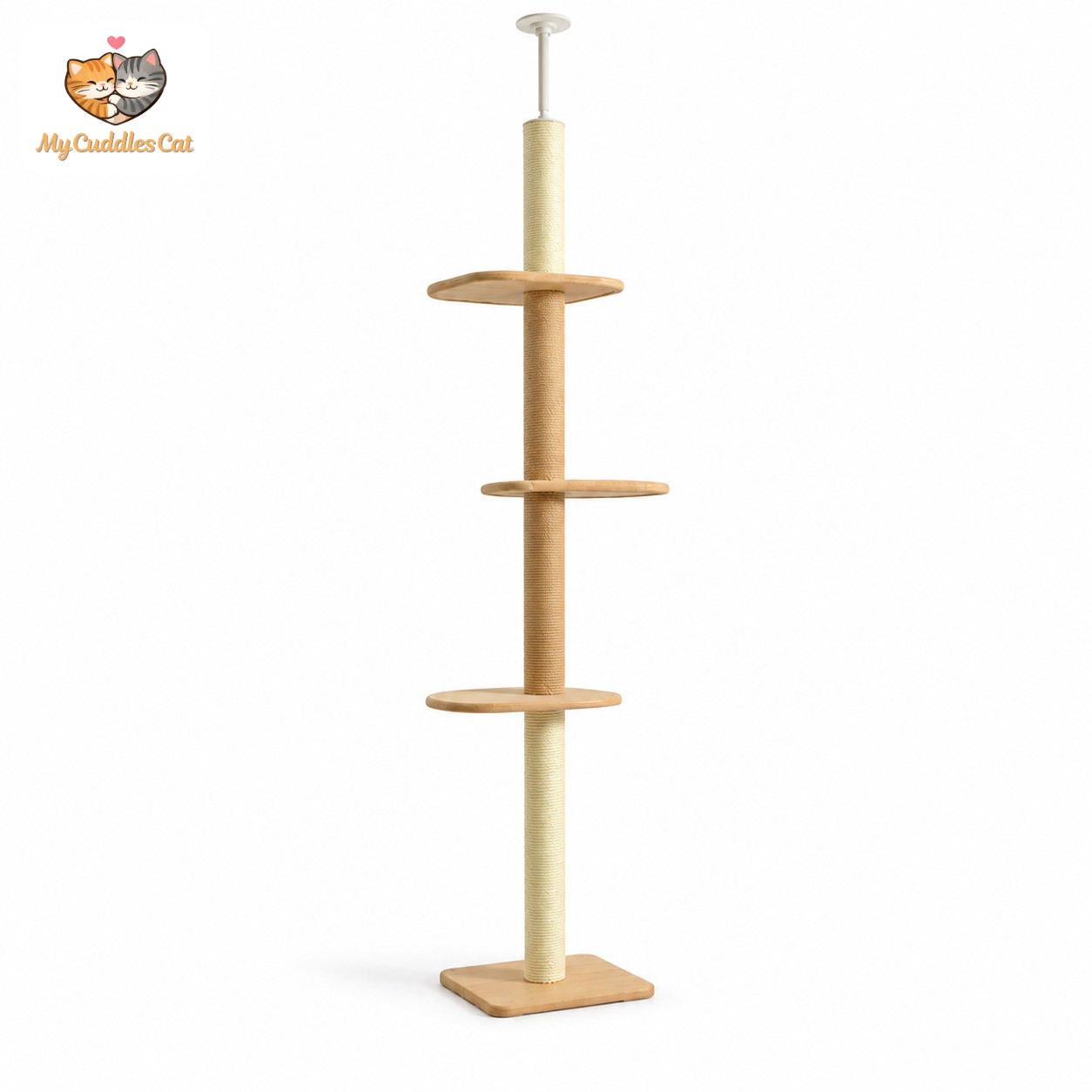
Anchored trees change the maths entirely. A floor-to-ceiling tension-pole tree is braced top and bottom, so it can be tall and narrow and still not rock. That is why our Summit Cat Tower can stand 89.75–102.25 in tall on a 17 × 10.75 in base: the ceiling pressure rod does the stabilising work a wide base would otherwise have to do.
2. Platform size — the spec most listings hide
A sleeping cat curls into a circle roughly 70% of its body length. A 20-inch cat needs a 14–16 inch platform to curl comfortably and an 18-inch or longer perch to lie stretched out. If a listing only gives the tree’s overall height and never mentions platform dimensions, assume they are small. Look for top perches with raised edges (bolster rims) too; big cats hang a leg over the side and a rim stops the slow slide off.
3. Weight rating per level, not for the whole tree
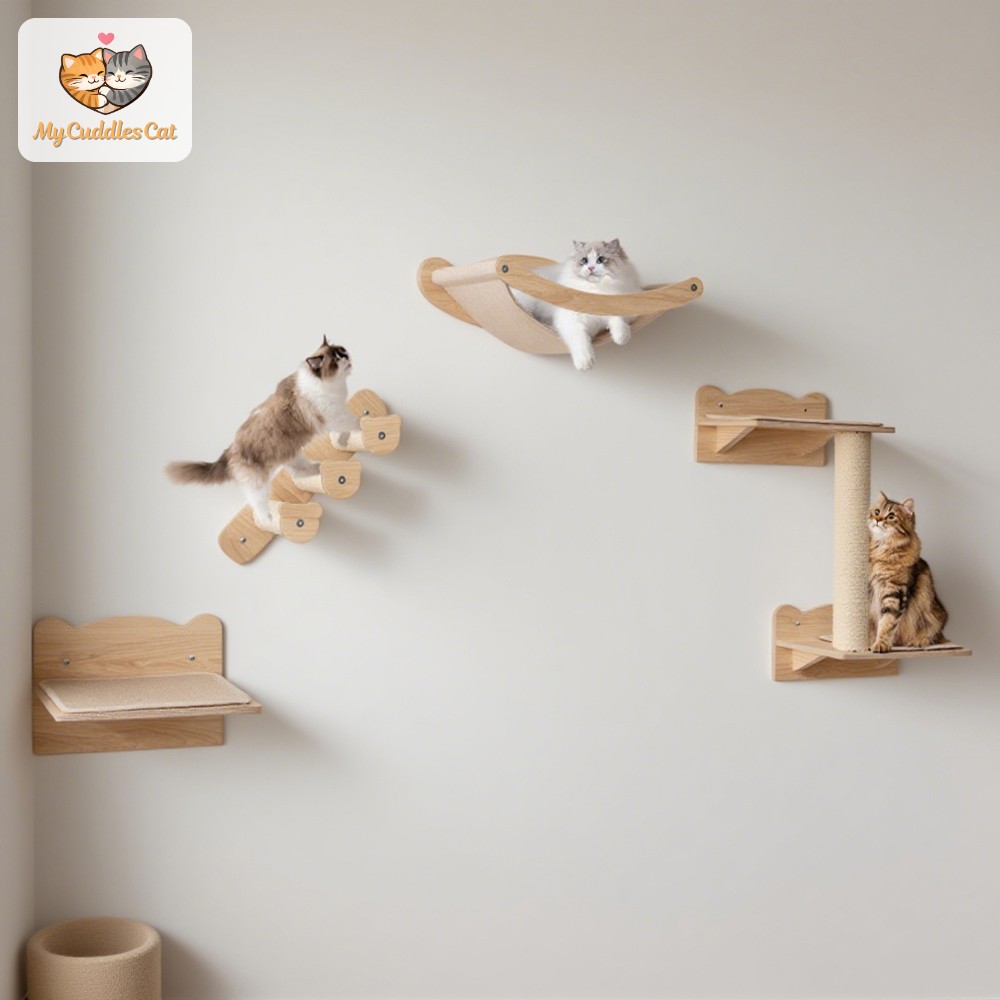
“Holds up to 40 lb” sounds reassuring until you realise it is the static total across every level. What matters is the dynamic load on one platform when a 15-lb cat lands from two feet up — roughly three times its body weight for a split second. Prefer trees where each platform is rated individually, and where the posts are solid wood or thick-wall cardboard tube wrapped in sisal rather than thin tube. Our Cat Wall Furniture Set, for example, is rated at 22 lb per piece, which is the figure you actually want to see.
4. Post diameter and scratching surface
Large cats scratch with more force and need a post they can wrap both front paws around: aim for posts 3.5 in or thicker and at least 30 in of usable sisal height so the cat can reach up to a full stretch. Thin posts wobble under a heavy cat’s pull, which is exactly when the tree starts rocking. If the tree you love has thin posts, pair it with a separate heavy post — see our guide to stopping furniture scratching for placement tactics.
Best cat tree styles for big cats, compared
| Style | Stability with a 15 lb+ cat | Floor space | Best for | Watch out for |
|---|---|---|---|---|
| Floor-to-ceiling tension pole | Excellent (braced top and bottom) | Smallest | Apartments, jumpers, multi-cat homes | Needs a flat ceiling 8–8.5 ft; re-tighten after a week |
| Modern wood tower (solid posts) | Good when base ≥ 1/3 height | Medium | Living rooms, design-led homes | Check platform size — style-first trees can run small |
| Wall-mounted shelves and perches | Excellent (bolted to studs) | Zero | Giant breeds, small rooms | Must hit studs or use proper anchors |
| Carpeted multi-level condo | Variable — often top-heavy | Largest | Budget, kitten-to-adult | Narrow condos, thin tube posts, short lifespan |
Best cat tree for Maine Coons and other giant breeds
Maine Coons regularly reach 18–22 lb and 40 inches nose-to-tail. For them the question is less “which tree” and more “which structure”. Two setups work consistently:
- A tension-pole tree as the vertical highway, with the top perch at least 16 inches across. The ceiling brace means a 20-lb landing does not rock the pole. Our Summit uses three platforms plus the base and tensions against ceilings from 89.75 to 102.25 in.
- Wall shelves as the lounging layer, staggered 12–16 inches apart vertically so a heavy cat steps rather than leaps. Four pieces rated at 22 lb each cover one wall of a normal room — see how we lay them out in our cat wall shelves planning guide.
Avoid enclosed condos or cubes unless the opening is 10 in or wider; most giant-breed cats will not squeeze into a standard 7–8 in hole, so that level becomes dead space.
Best cat tree for large cats in a small apartment
Big cat, small floor plan is the most common combination we hear about. The answer is to go up, not out: a floor-to-ceiling pole occupies about 1.3 sq ft of floor yet gives a large cat more climbing height than any 36-inch condo. Put it beside a window and the top perch doubles as a lookout. If even that footprint is too much, a sill-mounted perch like our Sunny Sill Window Perch adds a high resting spot with no floor space at all. We go deeper on layouts and measurements in Best cat tree for a small apartment.
Heavy-duty cat tree features worth paying for (and three that are marketing)
- Worth it: solid-wood or thick MDF platforms (not particleboard with a carpet skin), replaceable sisal posts, bolster rims on the top perch, a ceiling brace or wall strap, and a stated per-level weight rating.
- Marketing: “premium plush” (usually thin polyester), dangling toy balls (heavy cats tear them off in a day), and “anti-tip base” claims with no base dimensions given.
How to measure before you buy
- Weigh your cat (stand on a bathroom scale with and without them). Add 30% if they are under two years old.
- Measure nose-to-rump while they stand. Your minimum top-perch width is 70% of that number.
- Measure floor-to-ceiling at the exact spot for a tension tree; it must be flat drywall or plaster, not a popcorn or sloped ceiling.
- Check the base footprint of any free-standing tree against the one-third rule above.
- Confirm the entry size of any enclosed level is at least 10 in for cats over 14 lb.
Assembly and anchoring tips for a wobble-free tree
Even a well-built tree wobbles when it is assembled loosely. Tighten every bolt in two passes — snug first, then firm once the whole structure is up — and recheck after the first week, because sisal and wood settle. For tension poles, compress the rod until you cannot rotate it by hand, and put a furniture pad between the top cap and the ceiling to protect paint. Free-standing trees over 48 inches should be strapped to the wall with a furniture anti-tip kit (the same kind used for bookcases); it costs a few dollars and removes the only real failure mode for a large cat. Place the tree in a corner or against a wall rather than mid-room, and give it a few days: big cats are often cautious with new furniture, and a pinch of catnip on the top perch speeds things up.
Our picks for large cats
- Summit Cat Tower — floor-to-ceiling tension pole, 3 platforms + base, fits ceilings 89.75–102.25 in. The anchoring solves the tipping problem outright, and the tiny 17 × 10.75 in base makes it the right choice when a big cat lives in a small room.
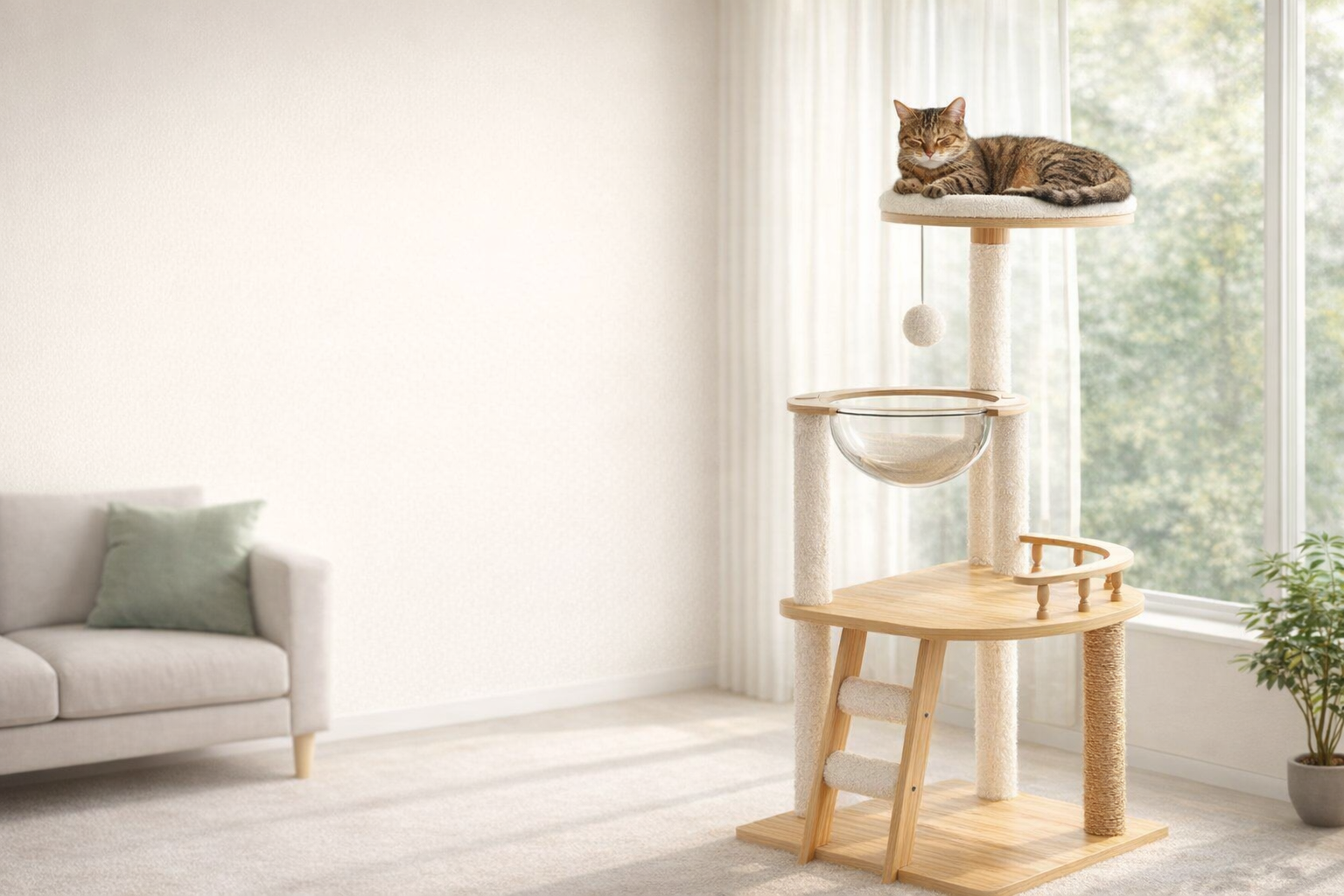
- Modern Cat Tower — 41 in or 49 in, MDF wood with sisal posts (two on the 41 in, three on the 49 in) and an acrylic hammock. Choose the 49 in for cats over 12 lb: the extra post adds rigidity, and the wood platforms do not sag the way carpeted particleboard does.
- Cat Wall Furniture Set — four wall-mounted pieces rated 22 lb each, with hammock and sisal stairs. Not a tree, but for a Maine Coon it is often the better buy.
- Mushroom Scratch Post — a heavy stand-alone sisal post to pair with any tree whose posts are too thin for a strong scratcher.
Frequently asked questions
How tall should a cat tree be for a large cat?
Height matters less than stability. A 48-inch anchored or wide-based tree is plenty for exercise; what a large cat needs most is a top perch wide enough to lie on. If you want more height, choose a floor-to-ceiling pole rather than a taller free-standing tree.
Can a cat tree hold a 20-pound cat?
Yes, if each platform is rated for at least 20–25 lb and the tree is anchored or has a base at least one-third of its height. Check per-level ratings, not the total.
Are wall shelves better than a cat tree for big cats?
For giant breeds in small homes, often yes: shelves bolted to studs cannot tip and take no floor space. The ideal is one vertical route (a pole or tree) plus two or three shelves for lounging.
How do I stop a large cat’s tree from wobbling?
Retighten all bolts after a week, strap free-standing trees to the wall with an anti-tip kit, and keep the tree against a wall or in a corner. If it still rocks, the base is too small for the height — replace it with an anchored design.
Related guides: Best cat tree for a small apartment · How to stop a cat scratching furniture · How to choose a cat bed · Browse all cat trees, towers and scratchers.