
Do Self-Warming Cat Beds Work? How They Work + Safety
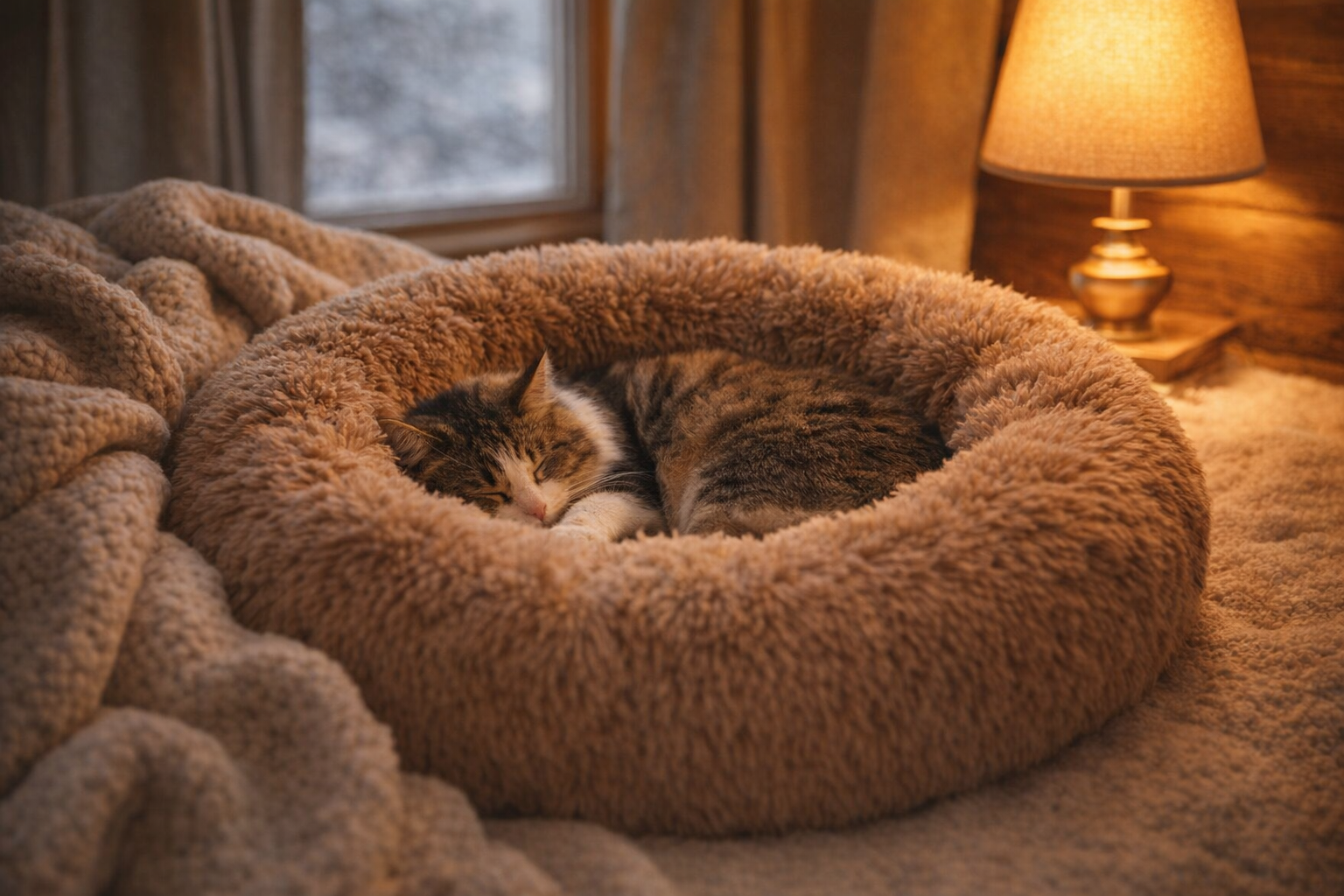
By the MCC team · 6 min read · Reviewed for accuracy
Yes — for most cats, a self-warming bed really does feel warmer, but it doesn’t create heat. It reflects and traps your cat’s own body heat, so it works best for cats who curl up to sleep, in rooms that run cool, and in a bed shape that holds warmth in. If your cat needs genuinely added heat — a stiff senior in a cold house, a hairless breed — a low-wattage electric heated bed does more, as long as it passes a few safety checks. Here’s how both work and how to pick the right one.
How a self-warming cat bed works
Cats run warm. A healthy cat’s normal body temperature sits around 100.5–102.5°F, and the temperature range where they’re comfortable without working to stay warm is far higher than ours — commonly cited at roughly 86–97°F. Your thermostat isn’t set anywhere near that, which is why cats chase sunbeams, radiators and warm laptops.
A self-warming bed closes part of that gap without a plug. Inside the cushion there’s a thin reflective or insulating layer — usually a metallized, Mylar-type film or a thermal-reflective foil, sometimes combined with dense insulating fill. The body heat that would normally radiate away into the room bounces back toward your cat. No cord, no batteries, no switch.
Think of it as a space blanket built into a cushion: it can only give back the heat your cat produces. That one fact explains every “does it work?” answer below.
So do self-warming cat beds actually work?
They work well when three things line up:
- Your cat stays put. Warmth builds over the first several minutes of a nap. A cat who hops on and off won’t feel much difference.
- The shape traps the warmth. Raised bolsters, donut rims and enclosed caves keep warm air around the cat. A thin flat pad loses most of it to the room.
- The floor isn’t stealing the heat. A bed on cold tile or a drafty window ledge loses warmth from below. Lift it off the floor or put a rug underneath.
Where they disappoint: very warm homes (your cat may skip the bed and stretch out on cool tile instead), cats who sleep sprawled flat rather than curled, and thin budget pads where the reflective layer is barely there. Some cats are also wary of the faint crinkle a new reflective layer makes; it usually softens with use.
Be skeptical of exact “stays X degrees warmer” claims on packaging. How much warmer a bed feels depends on the cat, the room and the bed’s shape. What you can realistically expect is a cushion that feels warm to the touch after a nap instead of room-temperature.
Self-warming vs. heated (electric) cat beds
| Self-warming | Electric heated | |
|---|---|---|
| How it warms | Reflects your cat’s own body heat | A low-wattage element adds heat |
| Power | None | Plugs in (often low-voltage) |
| Best for | Healthy adults, curlers, cool rooms | Seniors, stiff or hairless cats, cold rooms and porches |
| Safety watch-outs | Very few | Cord chewing, thermostat quality, overheating |
| Placement | Anywhere | Near an outlet, with the cord protected |
| Washing | Usually a machine-washable cover | Remove the heating pad before washing |
Electric isn’t automatically better. A healthy adult cat in a heated home is usually perfectly comfortable on a self-warming bed — and it’s the zero-risk choice for cats who chew cords.
Are self-warming cat beds safe?
Self-warming beds are one of the safest warm options precisely because there’s nothing to overheat: the bed can’t get warmer than your cat makes it, and your cat can simply get up if it’s too warm. A few sensible checks:
- The reflective layer should be sealed inside the cushion. A cat shouldn’t be able to reach film or foil. If yours shreds bedding, check the bed now and then and replace a torn insert.
- Always leave a cooler option nearby. Cats regulate their temperature by moving between spots — give them somewhere else to go.
- Retire damaged beds. Especially with kittens, who chew anything loose.
For an electric bed, look for a thermostat that keeps the surface near your cat’s body temperature, a chew-resistant or steel-wrapped cord, a safety listing such as UL or ETL, and a low-voltage or auto-off design. Don’t leave a heated pad under a cat who can’t easily move off it on their own.
One health note: if your cat suddenly seeks heat all the time, seems cold, or is losing weight, check with your vet. Constant heat-seeking can be a sign something else is going on, especially in senior cats.
Which cats benefit most
- Senior cats. Older cats often lose some of the muscle and body fat that keep them warm, and stiff joints tend to feel better when warm.
- Short-haired, slim or hairless cats. Less coat means faster heat loss — Sphynx and Devon Rex owners know this well.
- Kittens. Small bodies lose heat quickly, especially away from their littermates.
- Cats in cool homes. Basements, drafty apartments, and homes where the heat drops at night.
How to choose a self-warming bed your cat will use
- Match the shape to the sleeper. Curlers love donut and bolster beds; hiders want a cave or covered bed. Our guide to choosing a cat bed walks through the styles.
- Size snug, not huge. A bed slightly bigger than your curled-up cat holds warmth best. An oversized bed has more surface to lose heat from.
- Confirm the warming layer. A good listing tells you what the layer is and where it sits. Vague “warming” claims with no explanation are a red flag.
- Make sure it washes. Look for a removable, machine-washable cover and check how the reflective insert should be cleaned — usually a cool, gentle cycle and a low or air dry. More in how to keep cat gear clean.
- Non-slip base. A bed that skids across the floor gets abandoned.
Where to put it
Somewhere warm, draft-free and slightly raised, close to where your cat already likes to nap. A spot that catches afternoon sun adds free warmth on top. Then give it a week: cats are suspicious of new things, and rubbing the bed with a blanket your cat already sleeps on helps it smell like home.
If your cat prefers to hide rather than sprawl, an enclosed spot such as a felt cat house or a cardboard cat house keeps drafts off; add a blanket inside for extra warmth.

Self-warming cat bed FAQs
No. They have no plug or battery. A reflective or insulating layer inside the cushion bounces your cat’s own body heat back toward them.
It’s very unlikely, because the bed can only return heat your cat produces and your cat can leave whenever they like. In warm homes, keep a cooler resting spot available too.
Usually, but check the care label. Many have a removable cover; the reflective insert may need a gentle cycle or a wipe-down. Wash cool and air dry or tumble on low to protect the layer.
Often, yes — senior cats tend to lose body heat faster. For an arthritic cat in a cold house, a thermostat-controlled heated bed may give more relief; ask your vet what suits your cat.
Self-warming vs. a regular plush bed: is the difference real?
A thick plush donut already traps a lot of body heat, so the honest question is how much the reflective layer adds. In a room at normal household temperature (68–72 °F) the difference is modest — a few degrees at the surface after ten minutes — and most cats will not care. The gap widens sharply on cold floors, tile, in unheated rooms overnight or in a draughty hallway, where a plain bed loses heat into the floor and a self-warming bed does not. That is why we recommend them for specific cats and spots rather than as a blanket upgrade: seniors, thin or short-haired cats, post-surgery recovery, and any bed that sits on a hard floor in winter.
How to test whether your cat actually needs one
- Put a hand flat on the floor where the bed sits for 30 seconds. If it feels cold to you, it is colder to a cat lying on it for hours.
- Watch where the cat sleeps when the heating is off: on top of a radiator cover, on your laptop, in a sunbeam — all signs they are hunting warmth.
- Check whether they curl tightly (conserving heat) or sprawl (comfortable). Tight curling in a bed that should be cosy points to a cold surface.
- Older cats who have stopped using a favourite floor bed in winter are often cold, not bored.
Care and lifespan
The reflective layer is usually a thin metallised film quilted between fabric layers; it survives cold, gentle washing but not hot cycles, tumble heat or wringing, which crease and crack it. Wash cold, extra rinse, air dry flat, and expect two to three winters from a good bed. If the bed stops feeling warm to the touch after a few minutes with the cat in it, the film has failed and it is time to replace it. Keep the bed off radiators and out of direct sun in summer — a self-warming bed in a 85 °F room is simply too hot, and the cat will abandon it until autumn. For the full care routine see how to keep cat gear clean, and for choosing a size and shape see how to choose a cat bed.
Start here
Browse enclosed caves and bolstered beds that hold warmth in our Beds & Caves collection — every product page shows where it ships from and when it arrives, and every order is backed by our 15-day cat-approved guarantee. Shopping for someone else this season? See our Christmas gifts for cat lovers with order-by dates.
Not sure which bed your cat will actually use? Ask us — a real cat person will help.