
Why Does My Cat Throw Up After Eating? (It’s Usually Speed)
By the MCC team · 7 min read · Reviewed for accuracy
When a cat throws up after eating, the most common cause is simple: the food went down too fast. Cats that gulp a meal in under a minute swallow air and unchewed kibble, the stomach stretches, and the food comes straight back up, often looking almost exactly as it did in the bowl. This guide explains how to tell that kind of episode from something more serious, what you can change at home, and when to call your vet.
First, a safety check
Occasional regurgitation in an otherwise bright, hungry cat is common. Vomiting is also a symptom of many illnesses, so use this list before you change anything at home. Call your vet promptly if:
- Your cat vomits more than once or twice a week, or several times in one day.
- There is blood, or the vomit looks like coffee grounds.
- Your cat is lethargic, hiding, not eating, losing weight or drinking far more than usual.
- You suspect your cat swallowed string, a toy part, a plant or anything toxic.
- Your cat is a kitten, a senior, or has a known medical condition.
- Your cat keeps trying to vomit and nothing comes up.
This article is general information, not a diagnosis. When in doubt, check with your vet.
Regurgitation or vomiting?
The two look similar but mean different things.
- Regurgitation is passive. The food comes up within minutes of eating, with little or no heaving, in a tube shape, mostly undigested. It usually points to eating too fast or too much.
- Vomiting is active. You see drooling, lip-licking and abdominal heaving first, and what comes up is partly digested, sometimes with yellow or foamy liquid. It can happen hours after a meal.
If what you are seeing is regurgitation right after meals, the fixes below are a reasonable place to start. If it is true vomiting, or you are not sure, talk to your vet first.
Why cats eat too fast
- Competition. In a multi-cat home, a cat that thinks the food might be stolen eats as quickly as it can.
- Long gaps between meals. A cat fed twice a day can arrive at the bowl very hungry.
- Habit from kittenhood or a shelter, where meals were a race.
- Boredom. For some indoor cats, eating is the main event of the day.
- A deep, narrow bowl that makes each mouthful bigger.
Seven changes that slow a fast eater
1. Use a slow feeder
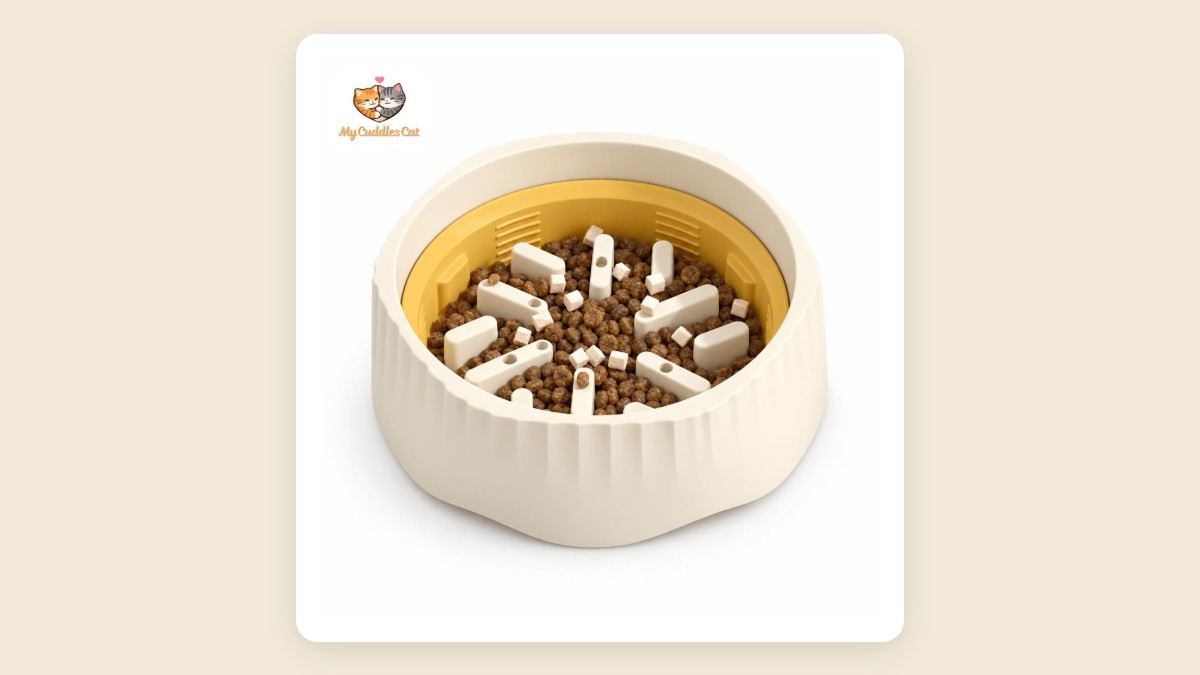
Ridges or a maze in the bowl force a cat to take small bites and work around obstacles. A meal that took 60 seconds can take several minutes, which gives the stomach time to signal that it is filling.
2. Try a puzzle feeder
A puzzle feeder hides kibble so the cat has to fish each piece out with a paw. It slows eating further and adds mental work, which also helps a bored cat.
3. Split the day into smaller meals
Four to six small meals are easier on the stomach than two large ones. If you are out during the day, an automatic feeder can dispense small portions on schedule.
4. Spread the food out
A handful of kibble scattered on a flat plate or a clean mat cannot be gulped in one go. It is the simplest test of whether speed is the problem.
5. Separate cats at mealtimes
Feed cats in different rooms, or at least out of sight of each other, and pick up the bowls afterwards. Removing the sense of competition often slows the fastest eater within days.
6. Check the bowl height and shape
A wide, shallow dish lets a cat eat without burying its whiskers, and some cats eat more calmly from a slightly raised dish. Raising the bowl does not cure a fast eater on its own, but it can help alongside the changes above.
7. Keep things calm after the meal
Hard play straight after eating can bring food back up. Play first, feed second, and let your cat rest.
Other common causes worth knowing
Speed is the usual reason, not the only one.
- Hairballs. Cats that groom a lot, and long-haired cats, bring up hair with food or foam. Regular brushing reduces how much hair is swallowed.
- A sudden diet change. Switch foods gradually over 7 to 10 days.
- Food intolerance. Some cats react to a particular ingredient; your vet can guide an elimination trial.
- Eating something they should not: plants, string, rubber bands, human food.
- Medical conditions, including problems with the stomach, intestines, kidneys, thyroid or pancreas. These need a vet, and they are the reason frequent vomiting should never be written off as normal.
How to tell whether the change is working
Give any change two weeks and keep a simple note: the date, how long after eating it happened, and what came up. If episodes drop from several a week to rare or none, speed was probably the cause. If nothing changes, or it gets worse, take the notes to your vet. They are more useful than memory.
What not to do
- Do not withhold food for long periods to rest the stomach unless your vet tells you to. Cats should not go without food for more than a day.
- Do not give human anti-nausea or stomach medicines.
- Do not punish a cat for vomiting. It is not a behavior choice.
- Do not assume a cat that vomits weekly is fine because it has always done so.
Feeding gear that helps
For gulpers, the Slow-Feast Maze Bowl has maze ridges that slow each bite, and the insert lifts out so it can be used as a regular bowl. It is 8.3 inches wide and 3.1 inches tall with non-slip feet. The Cat Puzzle Feeder hides dry food under a clear cover with an adjustable outlet for different kibble sizes, so every piece has to be worked out with a paw.
If long gaps between meals are the trigger, the Auto-Feast Smart Feeder dispenses up to 10 scheduled meals a day in portions of about 10 grams; our guide to the best automatic cat feeder explains how to set portions. For whisker comfort, the High-Rise Ceramic Cat Dish is a shallow 7.1-inch plate raised 3.3 inches. Browse everything in Feeding and Water.
Frequently asked questions
Is it normal for a cat to throw up after eating?
An occasional episode right after a fast meal is common. Vomiting more than once or twice a week, or with any other symptom, is not normal and should be checked by a vet.
Why does my cat throw up undigested food?
Undigested food that comes up within minutes usually means the cat ate too fast or too much. If it happens hours later or often, see your vet.
Do slow feeders stop cats vomiting?
They help when speed is the cause, because smaller bites and a slower meal reduce swallowed air and stomach stretch. They do not treat medical causes.
Should I feed my cat again after it throws up?
If your cat seems well, wait an hour or two and offer a small portion. If it vomits again or seems unwell, call your vet.
Does wet food cause less vomiting than dry food?
Some cats eat wet food more slowly and tolerate it better, but it varies by cat. Change food gradually and ask your vet if episodes continue.
When is cat vomiting an emergency?
Repeated vomiting in a day, blood, lethargy, pain, a swollen belly, unproductive retching, or a suspected swallowed object or toxin all need urgent veterinary care.