
Best Automatic Cat Feeder: What to Look For and How to Set It Up
By the MCC team · 7 min read · Reviewed for accuracy
The best automatic cat feeder is the one that delivers the right portion at the right time without jamming, and that you can trust on the days you are not home to check. This guide explains the types of feeder, the features that matter, how to set portions, and how to switch a cat over without stress.
Quick pick: the Auto-Feast Smart Feeder is the Wi-Fi feeder we stock: a 4-liter hopper, up to 10 scheduled meals a day and portions of about 10 grams. The rest of this guide explains what to look for.
What an automatic cat feeder does (and does not do)
An automatic feeder stores dry food in a hopper and drops measured portions into a bowl on a schedule. It solves three everyday problems: the 5 a.m. wake-up call, the uneven meal times of a busy week, and the cat that eats a day’s food in one sitting when it is free-fed.
It does not replace a person. Fresh water, litter and a daily look at your cat still need a human, so a feeder covers a long workday or a single night away, not a week’s holiday.
Types of automatic cat feeder
- Gravity feeders refill the bowl as it empties. They are simple and need no power, but they do not control portions, so they suit cats that self-regulate.
- Timed tray feeders have a few lidded compartments that open on a timer. They work for wet food over a short period but hold only a handful of meals.
- Programmable hopper feeders hold several liters of kibble and dispense set portions on a schedule. This is the type most people mean, and the one this guide focuses on.
- Wi-Fi feeders are hopper feeders you control from a phone app, so you can change the schedule or feed a meal while away and see a record of what was dispensed.
Seven features that matter
1. Portion control
Look for small, consistent portions. A feeder that dispenses in units of about 10 grams lets you fine-tune a diet; one that only offers large scoops makes weight management hard.
2. Number of meals per day
Cats do best on several small meals. Four to six meals a day is a sensible target for most adult cats, so choose a feeder that allows at least that many.
3. Capacity
A 4-liter hopper holds roughly 16 to 17 cups of kibble, which is well over a week of food for one average cat. Bigger is not better if the food goes stale, so check for a sealed lid and a desiccant holder.
4. Backup power
A power cut should not mean a missed meal. Dual power, with a wall adapter for daily use and batteries as backup, is the feature that separates a feeder you can rely on from one you cannot.
5. Alerts
Low-food and low-battery alerts tell you about a problem before your cat does.
6. Bowl material
Stainless steel is the easiest to keep clean and does not hold odor the way scratched plastic can.
7. Ease of cleaning
The hopper, lid and bowl should come off for washing. Food oils go rancid, so plan to wash the food path every one to two weeks.
Is your cat a good candidate?
An automatic feeder suits most healthy adult cats on dry food. It is especially useful for:
- Cats that wake the house for breakfast. When the machine is the source of food, the pre-dawn campaign usually moves from your bedroom to the feeder.
- Cats that gulp a large meal and bring it back up. Smaller, more frequent meals are easier on the stomach.
- Cats on a weight plan, where consistent measured portions matter more than anything else.
- Households with shift work or changing hours.
It is a poor fit for cats that eat only wet food, for cats that need medication mixed into a meal, and for any cat whose appetite you need to watch closely. In those cases feed by hand so you see every meal being eaten.
Where to put the feeder
Set it on a hard, level floor against a wall, away from the litter box and a few feet from the water. Avoid direct sun, which warms the hopper and speeds up staleness. If you have a dog or a toddler, choose a spot they cannot reach: both are better at opening feeders than cats are. Keep the power cable behind the unit, and check once a week that the bowl is seated properly so food does not spill behind it.
How to set portions
Start from the daily amount on your cat food’s feeding guide for your cat’s target weight, or the amount your vet recommends. Weigh that amount once on a kitchen scale so you know how many grams it is, then divide it across the day.
- Example: if the daily amount is 60 grams and your feeder dispenses about 10 grams per portion, that is 6 portions a day. You could schedule six meals of one portion, or three meals of two.
- Kibble size and shape change how much drops per portion, so weigh what the feeder actually dispenses during the first few days and adjust.
- Re-check your cat’s weight after two to three weeks and adjust by a portion at a time.
Kittens, seniors and cats with medical conditions have different needs; ask your vet before changing how they are fed.
Wi-Fi or no Wi-Fi?
A basic programmable feeder is enough if your routine is fixed. A Wi-Fi feeder earns its price when your days are irregular: you can move dinner later from the office, add a meal, and check the feeding record to confirm meals were dispensed. Check two things before you buy: most smart feeders connect only to 2.4 GHz home Wi-Fi, and a good one keeps running its saved schedule if the connection drops.
Switching your cat to a feeder
- Days 1 to 3: place the feeder next to the usual bowl, unplugged, with a little food in its bowl.
- Days 4 to 6: run the scheduled meals while you are home so your cat links the sound with food.
- Day 7 onward: remove the old bowl. Keep meal times the same as before for the first two weeks.
A nervous cat may be startled by the motor at first. Putting a few treats in the bowl just before a scheduled drop usually fixes that within days.
Multi-cat homes
One feeder for two cats works only if both eat calmly and need the same food and amount. If one cat guards the bowl or one is on a diet, use one feeder per cat in separate spots and watch a few meals to see who eats what.
Mistakes to avoid
- Filling the hopper to the top with a month of food. Kibble goes stale once the bag is open.
- Using very large, oily or irregular kibble in a feeder designed for small round pieces, which is the main cause of jams.
- Skipping the batteries, then losing a day of meals in a power cut.
- Treating the feeder as a pet sitter for a long trip.
Our pick
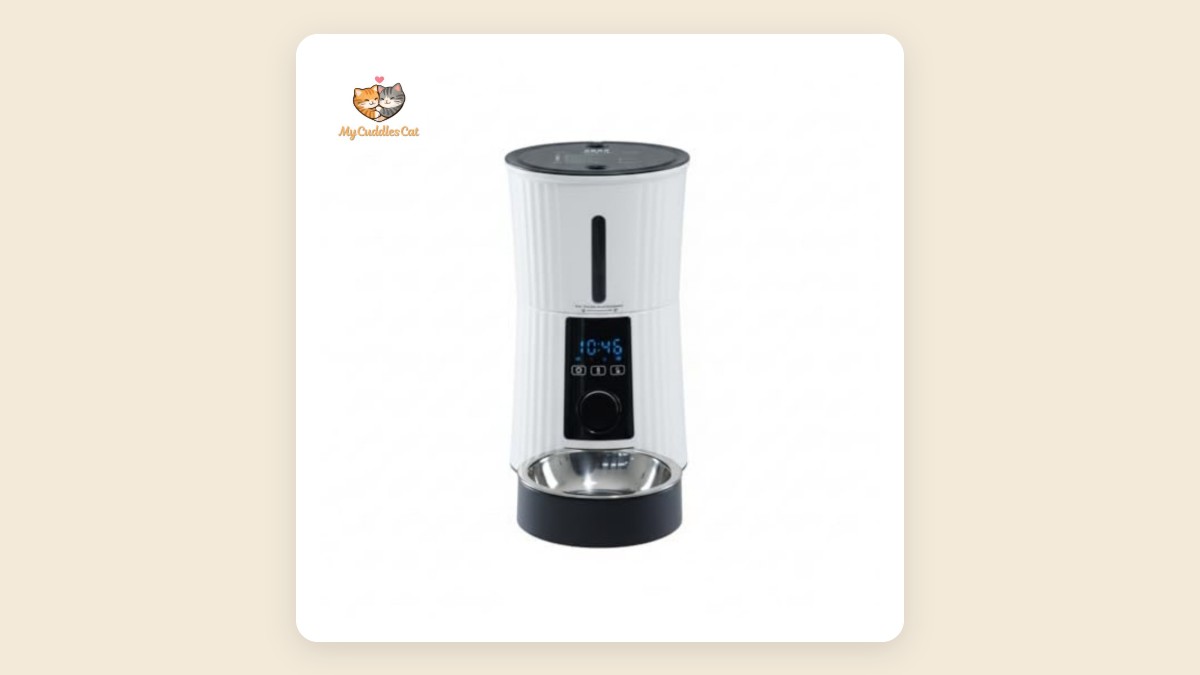
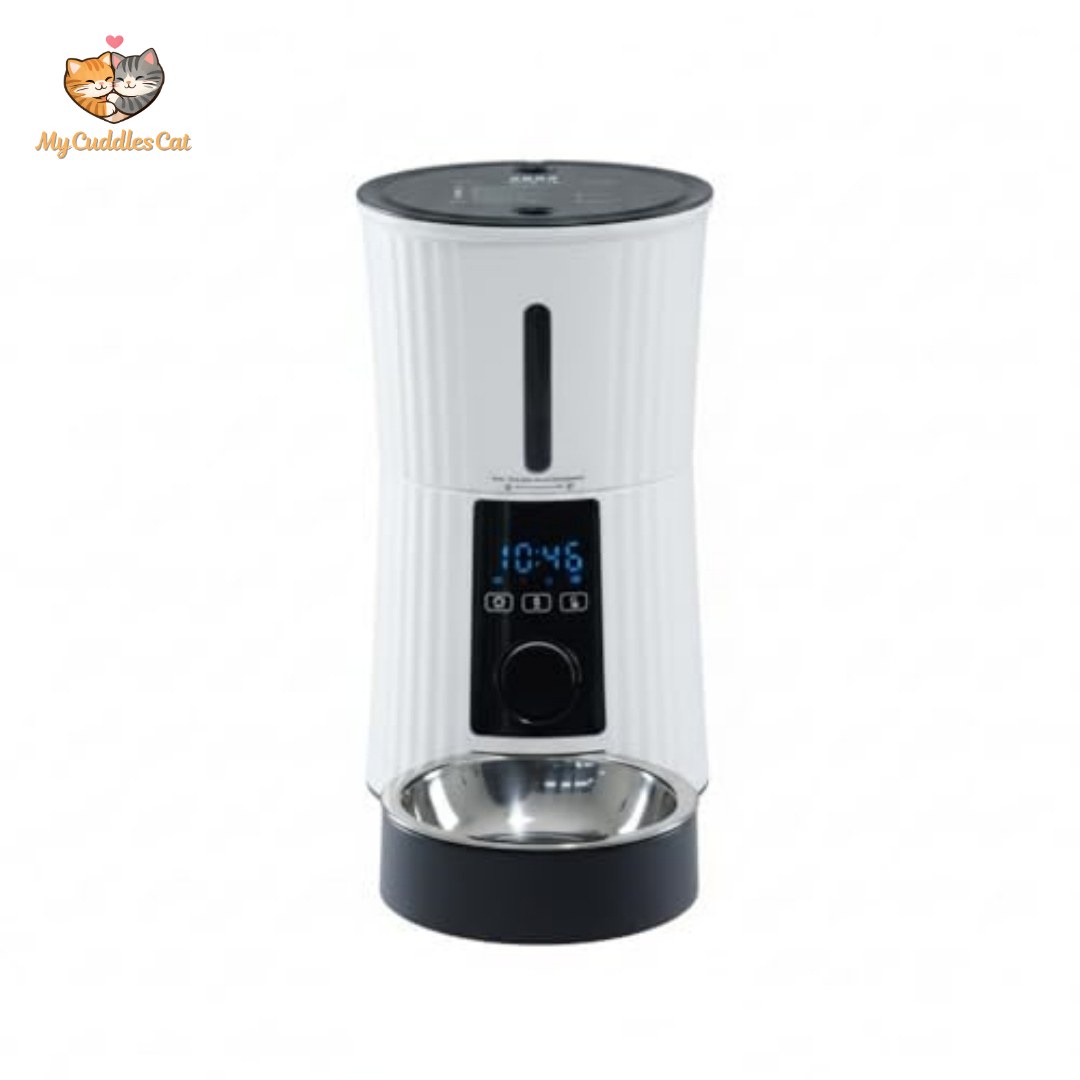
The Auto-Feast Smart Feeder is the automatic cat feeder we stock. It is a Wi-Fi feeder with a 4-liter (about 16.9 cup) hopper, up to 10 scheduled meals a day, and 1 to 50 portions per meal at about 10 grams each, with a 7-day feeding record in the app. It runs on a 5 V adapter with three D batteries as backup (batteries not included), has a stainless steel bowl and a desiccant box to keep kibble dry, and sends low-food and low-battery alerts. It comes in white or black and measures 12.99 x 7.48 x 13.50 inches.
If your cat’s problem is speed rather than timing, a cat puzzle feeder or the Slow-Feast Maze Bowl slows each meal down. For water, see our guide to choosing the best cat water fountain, and browse everything in Feeding and Water.
Frequently asked questions
Are automatic cat feeders worth it?
Yes, if your schedule is irregular, your cat wakes you for breakfast, or your cat needs measured portions. They are less useful for cats that eat only wet food.
Can I leave my cat alone with an automatic feeder?
For a long workday or one night, a reliable feeder with backup power is fine for a healthy adult cat. For longer absences, arrange for someone to visit: cats also need fresh water, a clean litter box and a daily check.
How many times a day should a feeder dispense?
Four to six small meals suit most adult cats. Keep the daily total the same and split it evenly.
Do automatic feeders work with wet food?
Hopper feeders are for dry food only. Wet food needs a timed tray feeder and should not sit out for long.
What happens if the Wi-Fi goes down?
Good smart feeders store the schedule on the device and keep feeding. You lose remote control and notifications until the connection returns.
How do I stop my cat breaking into the feeder?
Choose a feeder with a locking lid, keep it against a wall, and make sure meals are frequent enough that your cat is not very hungry between them.