
Best Cat Carrier: How to Choose for Vet Visits, Car Trips and Walks
By the MCC team · 7 min read · Reviewed for accuracy
The best cat carrier is the one your cat will walk into, that fits where you need it to go, and that keeps your cat secure the whole way. That answer changes with the trip: a five-minute drive to the vet, a weekend in the car and a flight each call for something different. This guide covers carrier types, sizing, safety in the car, when a stroller makes sense, and how to get a cat to accept a carrier without a fight.
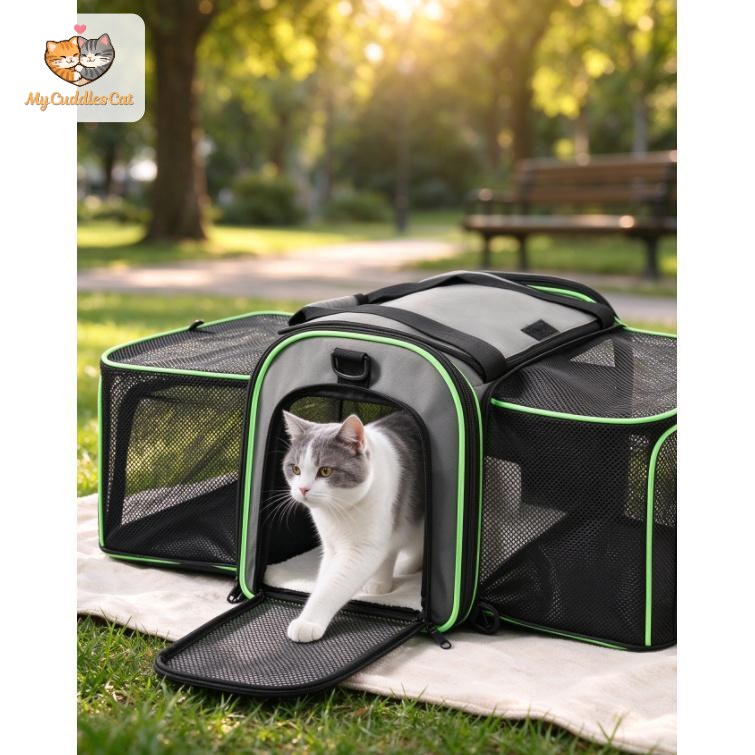
Quick pick: for vet visits and car trips we stock the Expandable Cat Carrier, a soft-sided carrier for pets up to 22 pounds with two zip-out side extensions. Read on to check it suits your cat and your trip.
Start with the trip, not the carrier
- Vet visits and short drives: easy loading matters most. Look for a wide opening or a top entry.
- Long car trips: room to turn around, good airflow and a way to strap the carrier to the seat.
- Flights: the airline’s size limit decides everything. Check it before you buy.
- Walks and outdoor time for an indoor cat: a stroller or a backpack, not a hand carrier.
Most households end up with one everyday carrier and, if they travel or have a cat that enjoys the outdoors, a second option for that purpose.
Types of cat carrier
Hard-sided carriers
Rigid plastic with a wire door. They are the easiest to clean after an accident, stack well and protect best against knocks. They are also bulky to store and less comfortable to carry.
Soft-sided carriers
Fabric over a light frame with mesh panels. They are lighter, more comfortable on a shoulder, and fold flat. A good one has a firm base so it does not sag, lockable zips and mesh on several sides.
Expandable carriers
A soft carrier with zip-out mesh sections that add floor space once you have arrived. They are useful for long drives, hotel rooms and waiting rooms, because the cat can stretch out without leaving the carrier.
Backpacks
Hands-free and good for stairs and public transport, but small inside. They suit confident cats and short trips.
Strollers
A zipped cabin on wheels. Strollers are for cats that are too heavy to carry far, for owners who cannot lift a loaded carrier, and for giving an indoor cat safe time outside.
How to size a cat carrier
Measure your cat from nose to the base of the tail and from floor to the top of the head while standing. The carrier should be a little longer than the first number and a little taller than the second, so your cat can stand, turn and lie down. Bigger is not always better: in a carrier that is far too large a cat slides around in the car and feels less secure.
Check the weight rating as well as the dimensions, and weigh your cat rather than guessing. For two cats, use two carriers unless they are small, bonded and calm together.
What a good carrier costs you in effort, not just money
The carrier you use is better than the carrier you own. Before you choose, think through the whole routine:
- Storage: a hard carrier needs a shelf; a soft or expandable one folds flat under a bed.
- Loading: a top or wide front opening saves a struggle with a cat that braces its legs.
- Carrying: check the handle and strap with weight in it. A padded shoulder strap matters once the load passes 12 pounds or so.
- Arrival: in a hotel room or a relative’s house, an expandable carrier gives a nervous cat a familiar base that is bigger than a box.
Multi-cat and large-cat households
Large breeds and heavy cats outgrow standard carriers quickly, so go by measurements and the weight rating rather than a label such as medium or large. If your cat is close to the limit, size up or consider a stroller, which carries the weight on wheels. For two cats, plan on one carrier each: even friendly cats can turn on each other when stressed in a small space, and two carriers are easier to balance in the car.
Safety checklist
- Zips that lock or clip together, so a paw cannot work them open.
- Mesh on at least two sides for airflow, made of a weave that resists claws.
- A firm, washable base pad.
- A strap or loops for the car seat belt. In the car, a carrier belongs on the back seat, strapped in, or on the floor behind a front seat, never loose and never on a front seat with an airbag.
- A leash clip inside is useful, but attach it to a harness, not a collar.
Flying with a cat
Every airline sets its own limits for in-cabin carriers, and they are often smaller than people expect, commonly around 17 to 18 inches long and 11 inches high for a soft carrier, with a combined weight limit for cat and carrier. Always check your airline and aircraft before you buy, and book the pet in advance because spaces are limited. A carrier that is ideal for the car may be too large to go under a seat.
When a cat stroller makes sense
A stroller is not a novelty if it solves a real problem:
- Your cat is heavy. A 15-pound cat in a carrier is hard to carry more than a block.
- You have a back, shoulder or wrist problem.
- You have an indoor cat that is curious about the outdoors but not safe off-leash.
- You have a senior cat that enjoys fresh air but cannot walk far.
Look for a fully zipped cabin with mesh windows, a brake, a weight rating above your cat’s weight, and a frame that folds for the car. Three wheels turn more easily; four wheels feel steadier on uneven ground. Introduce it indoors first, with the cabin open and a familiar blanket inside.
Getting your cat to like the carrier
- Leave the carrier out, open, in a room your cat uses, for a week or more before a trip.
- Put a worn T-shirt or their usual blanket inside.
- Feed treats near it, then just inside the door, then at the back.
- Close the door for a few seconds, then a minute, then carry it across the room.
- Take a short drive that ends at home, not at the vet.
For a cat that is already afraid, load from the top if you can, or stand the carrier on end and lower the cat in hind legs first. Cover the carrier with a light towel in the waiting room.
Cleaning and care
Wipe down hard carriers with mild soap after each use. For soft carriers, wash the removable pad and spot-clean the fabric; let everything dry fully before storing. Our guide to keeping cat gear clean covers stain and odor removal.
Our picks
For car trips and vet visits, the Expandable Cat Carrier is a soft-sided carrier measuring 20.5 x 13.4 x 13.4 inches for pets up to 22 pounds. Two zip-out mesh extensions add room on both sides once you arrive, and it has a car seat-belt strap, a luggage sleeve, a padded handle and shoulder strap, and a removable fleece pad. It folds flat for storage. At this size it is larger than many airline under-seat limits, so check with your airline before flying with it.
For walks, the Cat Stroller has an enclosed cabin with mesh windows, three wheels with a rear brake, a one-hand fold and a storage basket, and holds up to 35 pounds. If you want one product for both the pavement and the car, the Pet Stroller with Detachable Carrier has a cabin that lifts off its four-wheel frame and can be secured on a car seat.
See everything in Carriers and Travel, and if you are preparing for a first cat, our new kitten checklist lists what to buy before day one.
Frequently asked questions
Is a hard or soft carrier better for cats?
Hard carriers are easier to clean and more protective; soft carriers are lighter and more comfortable to carry. For most vet visits and car trips, a well-made soft carrier with a firm base is enough.
What size carrier does my cat need?
One that lets your cat stand, turn around and lie down: slightly longer than your cat from nose to tail base and slightly taller than your cat standing.
Can two cats share a carrier?
Only if they are small, bonded and calm, and the carrier is rated for their combined weight. Two carriers are safer.
How long can a cat stay in a carrier?
For a healthy adult cat, a few hours is fine. On longer drives, stop every two to three hours to offer water and a litter break inside the closed car.
Do cats like strollers?
Many do once they are used to them. Confident, curious cats take to a stroller quickly; nervous cats need slow, indoor introductions and may prefer to stay home.
Should I put food and water in the carrier?
Not for short trips. For long journeys, offer water at stops and a small meal a few hours before leaving rather than just before.